Farm check: has the rain started on your farm?
A free, phone-friendly check for any farm: whether the rains have started, when they usually start, rain and heat for the next 10 days and how green the crops are. Examples from Lilongwe, Malawi, and Gazipur, Bangladesh.
Key takeaways
- Farm check answers four questions for any spot: have the rains started, when do they usually start, what are the next 10 days' rain and heat, and how green are the crops compared with other years.
- It takes about 10 seconds the first time and 2 or 3 seconds after that, and works on a phone over a slow connection.
- Every answer comes as a one-page print sheet and a short text message for WhatsApp or SMS, so extension workers and lead farmers can pass it on.
- Each answer links to the national meteorological service for official forecasts and warnings, and to the regional climate centre for the seasonal outlook.
The most common question at the start of a growing season is a simple one: have the rains started yet, and is it safe to plant? Farm check answers it for any farm. Tap your spot on a phone and within a few seconds you’ll see:
- Have the rains started? Yes, not yet, or the season is over, with the rain so far.
- When do they usually start? The usual range over the last 30 years, and how often a first rain was followed by a dry week.
- Rain and heat in the next 10 days. Day by day, with hot days picked out.
- How green is it compared with other years? Whether crops and pasture around you are greener or less green than usual.
It’s free, it needs no account, and it works on a slow connection.
Two farms on 30 October 2026
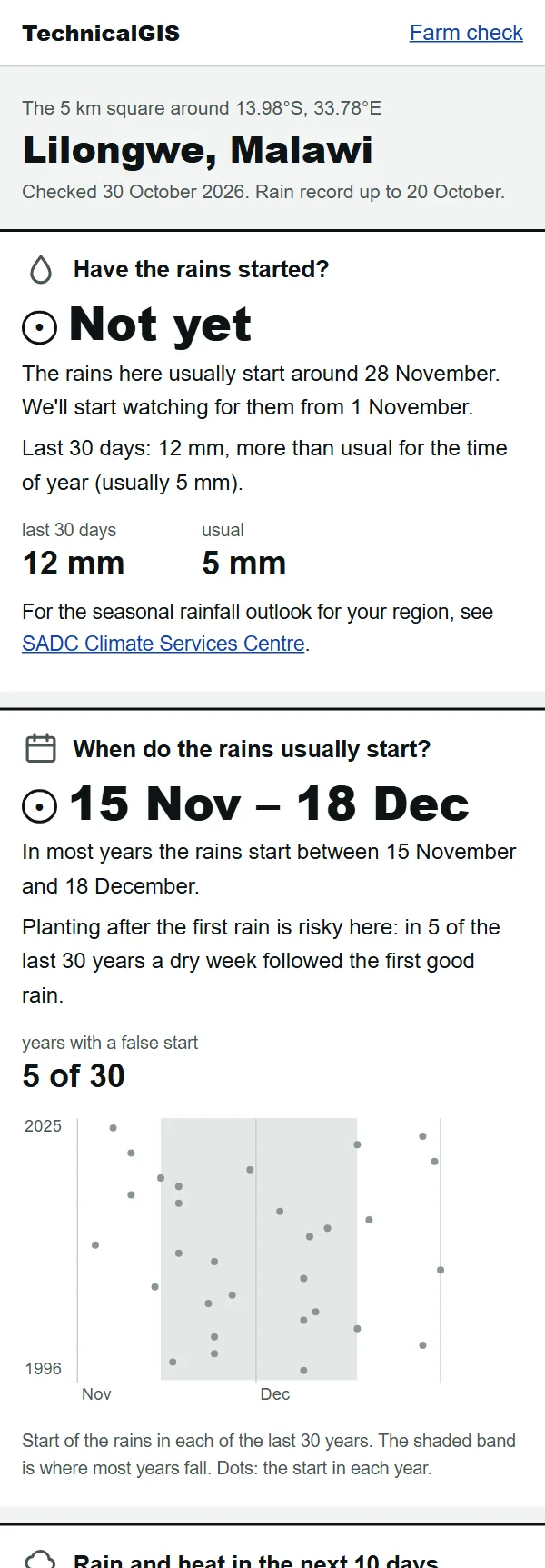
Lilongwe, Malawi: not yet
Central Malawi grows maize in one long rainy season. On 30 October the answer for a farm near Lilongwe was clear: the rains haven’t started.
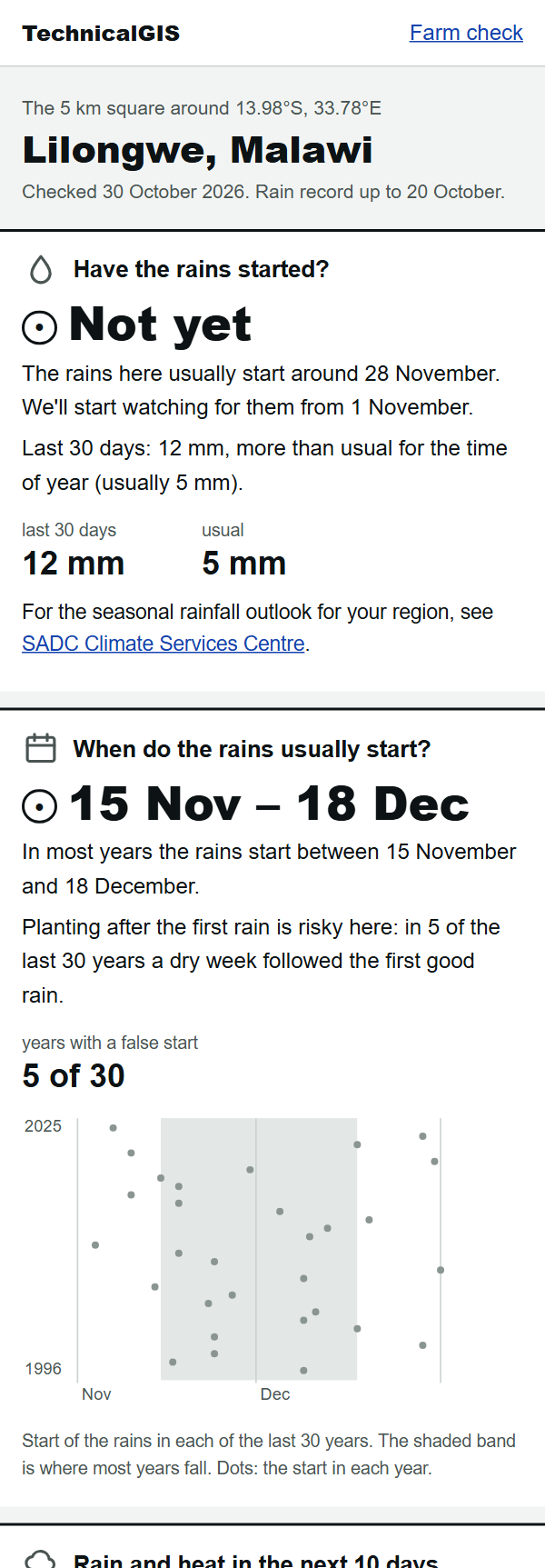
- Have the rains started? Not yet. They usually start around 28 November, and the check starts watching for them from 1 November. There was 12 mm in the last 30 days, a little more than the usual 5 mm for this dry time of year.
- When do they usually start? Between 15 November and 18 December in most years. In 5 of the last 30 years a dry week followed the first good rain, so planting on the very first rain is a risk here.
- Next 10 days: little or no rain, with highs of 32 to 36°C and 35°C or more on three days. A heat warning for crops and animals.
- Greenness: much greener than usual for the time of year.
The text version, ready to send, is 263 characters:
Farm check Lilongwe, 30 Oct: Rains not started yet. Usually start 15 Nov-18 Dec. Next 10 days: dry, highs up to 36C. Hot days ahead. Crops much greener than usual. Satellite estimate, check your fields. technicalgis.com/farmers/r/a902268c5c30ac301e40f47d5d2b5484/
The answer also points to Malawi’s Department of Climate Change and Meteorological Services for official forecasts and warnings, and to the SADC Climate Services Centre for the seasonal outlook.
Gazipur, Bangladesh: season over
Gazipur, just north of Dhaka, grows rice through the monsoon. By late October the main rains are behind it.
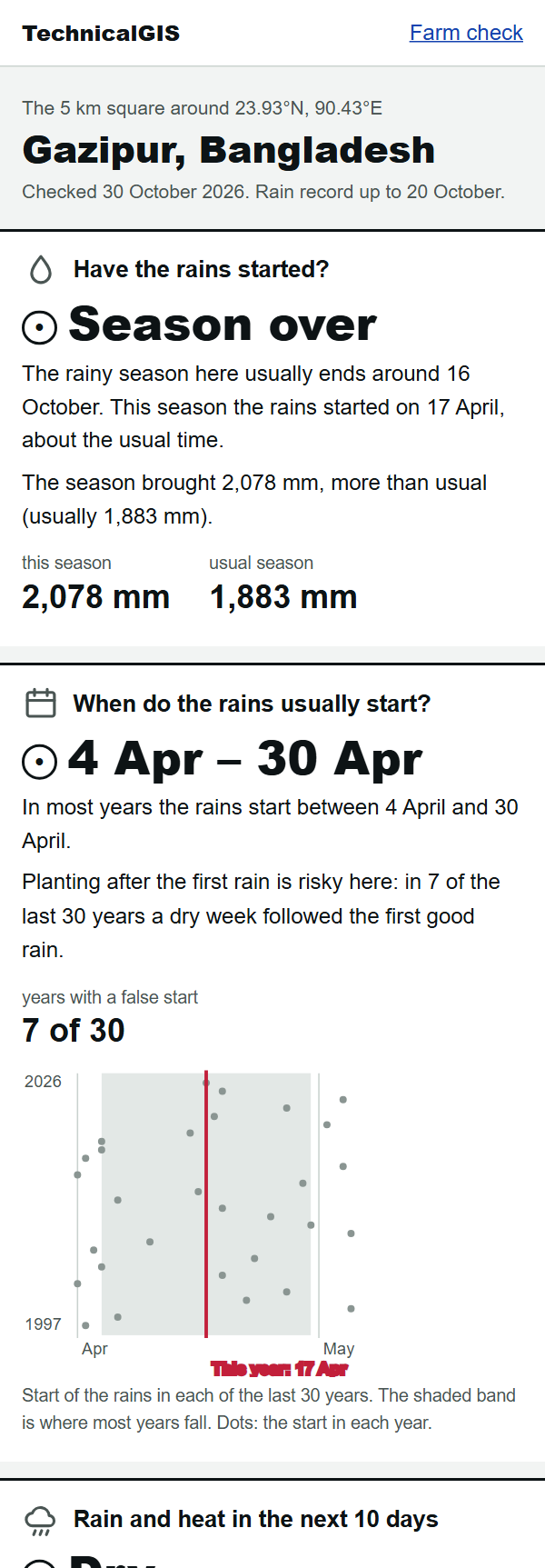
- Have the rains started? The season’s over. It usually ends around 16 October; this year the rains started on 17 April, about the usual time, and brought 2,078 mm against a usual 1,883 mm.
- When do they usually start? Between 4 and 30 April.
- Next 10 days: little or no rain, highs of 31 to 33°C.
- Greenness: about as green as usual.
Farm check Gazipur, 30 Oct: Rainy season over (rains started 17 Apr). Next 10 days: dry, highs up to 33C. Crops about as green as usual. Satellite estimate, check your fields. Official warnings: Bangladesh Meteorological Department. technicalgis.com/farmers/r/71e985092792ea5742c386573d1ba374/
We ran the same check in Yatenga, northern Burkina Faso, a sorghum and millet area: season over, 633 mm against a usual 738 mm, and highs of up to 41°C ahead. The answer sends people to the Agence Nationale de la Météorologie and to AGRHYMET for the regional outlook.
For extension workers and lead farmers
Most farmers hear about the weather from someone they trust: an extension officer, a cooperative, a lead farmer or a radio programme. Farm check is built to make that easy.
- Print it. Every answer prints on one A4 page, with big type and the four answers in plain words. Pin it up at a meeting point or hand it round.
- Send it. Every answer has a short text of under 300 characters. Copy it with one tap or send it straight to WhatsApp, and it fits in two SMS messages.
- Share the link. Each answer has its own address and stays up for 7 days. Anyone who checks the same spot that day gets the stored answer at once.
- Check a district. If you don’t have a location, search for the district by name and the check uses its centre.
The words are written so you can read them out as they are: “Not yet. The rains here usually start around 28 November.”
Where the official word comes from
Your national meteorological service issues the official forecasts and warnings, and your regional climate centre issues the seasonal outlook. Farm check doesn’t replace them. It adds what they rarely have room for: a check for one farm, against 30 years of rain at that spot. Every answer names and links the national service for that country, from the WMO’s World Weather Information Service, and, in Africa, the regional climate centre: ICPAC in the east, AGRHYMET in the west and the SADC Climate Services Centre in the south.
How it works
Rain so far and the usual start come from CHIRPS version 3, daily rain estimates at about 5 km from the Climate Hazards Center at UC Santa Barbara, blending satellite data with rain gauges from 1981. The rains are counted as started on the first day that at least 20 mm falls within three days, as long as no dry week follows in the next 30 days. This is the rule most agronomists use for planting advice, from Stern’s work in the 1980s onwards. The usual start is the middle 20 of the last 30 years. CHIRPS runs about 10 days behind, so the answer says how up to date the rain record is.
The next 10 days come from NOAA’s Global Forecast System, run four times a day and served by dynamical.org. The check uses the latest run’s daily rain and highest temperature.
Greenness comes from NASA’s MODIS vegetation index at 250 m, averaged over the square around your farm and compared with the same weeks in every year since 2000.
Your location is rounded to the 5 km square used by the rain data before it leaves your phone, and only the square is stored. The cookie policy has the details.
Try it
Open Farm check, tap “Use my location” or find your district, and check your farm. If you run a programme that would like Farm check in another language, or on a service your farmers already use, get in touch. For whole districts and past seasons, try the community tools.
Key terms
- Onset of the rains
- The first time at least 20 mm falls within three days, without a dry week in the following 30 days. The rule is widely used for planting advice in Africa and South Asia.
- False start
- A first good rain followed by a dry week or more, which can kill seedlings planted straight after it.
- NDVI
- Normalised Difference Vegetation Index, a satellite measure of how green and dense plants are.
Data for this article
- CHIRPS rainfall · Daily rain estimates from 1981, 0.05°
Licences and formats for each source are listed in the GIS data sources catalogue.